
Quick answers
Frequently Asked Questions
Short, direct answers to the questions we hear most. For the full picture, see What It Is and Concerns & Responses.
In depth: Data Center Noise & Infrasound FAQ — a detailed look at the noise, low-frequency sound, and infrasound claims circulating on social media, and what a credible study should measure.
The Basics
If these projects are manageable, why are so many communities against them — and why does the county have a moratorium?
A fair question — and the honest answer isn’t that those communities “don’t get it.” Most opposition is a reasonable reaction to real problems with how projects were done, not to the technology itself:
- Some facilities elsewhere were sited badly — built across the street from homes, run on diesel generators, or dropped into water-stressed areas. Residents were right to push back. The lesson isn’t “never” — it’s set strong rules and the right site first (see Concerns & Responses).
- Many fights were really about process — deals made quietly and sprung on people, so they felt blindsided. That’s why we’re doing this in the open, before anyone has approached us (see Transparency).
On the moratorium: a moratorium is usually a community hitting pause to catch up — it got approached before it had rules in place, so it stopped to study the issue and write standards. That’s prudent. The only difference is timing: a moratorium is the reactive version of caution; writing clear, strict standards before a developer ever calls is the proactive version of the same caution. (Linn County’s current moratorium is part of why any project would have to come into the City and meet our standards.)
And to be clear: some communities genuinely shouldn’t host these, and a “no” can be the right answer for that place. So the real question was never “data center, yes or no?” — it’s “are the rules strong enough, and is the site right?” — and we’re answering that before we’re ever under pressure.
Where opposition is driven by distrust or misinformation, the fix isn’t to dismiss anyone — it’s to put accurate, sourced information in front of you so you can judge for yourself. That’s the whole reason this site exists. (For a short, non-partisan guide to sorting good information from bad on this topic — claims for and against — see Weighing What You Read.)
What is an overlay district, in plain English?
It’s an extra layer of zoning rules placed on top of the normal zoning for a mapped area. It doesn’t erase the existing zoning — it adds specific standards for certain uses (here, technology and advanced industry). Think of it as a set of “house rules” that apply only inside the marked area, on top of the rules that already exist.
Won't this change the character of our community?
This may be the most important question on this page, and it deserves an honest answer — not a sales pitch. Protecting Linn Valley’s character is the City’s stated first priority, and it’s the reason the rules are written the way they are.
A few honest points:
The overlay is confined to one area — away from homes and the lake. The district for the large uses is focused east of US-69, deliberately separated from the residential neighborhoods, the POA community, and the lake that define Linn Valley (see where it could go). It is an overlay — it adds carefully-controlled options in a specific area; it does not rezone your home or your neighborhood, and it does not turn Linn Valley into an industrial town.
If anything is ever built, the rules are designed to make it fit, not dominate. A project would have to meet standards for separation and setbacks from homes, landscaping and screening, dark-sky lighting that keeps the night sky dark, and architectural quality so it isn’t a plain industrial box. And unlike a factory or warehouse, these uses bring very little day-to-day traffic — good tax base, without the trucks.
Doing nothing also changes a community. This part is easy to miss: right now nearly the entire tax burden falls on homeowners, and steadily rising property taxes change a town, too — they change who can afford to live here. A non-residential taxpayer can ease that pressure and help Linn Valley stay the community it is, rather than slowly pricing people out (more on Why We’re Considering It).
The honest bottom line: every community has the right to decide a use isn’t right for it. That’s why nothing is allowed by-right — every project goes through a full public process where residents weigh in, and the City has said plainly it would rather set the bar so high that nothing ever comes than lose control of what does. The goal isn’t to change Linn Valley. It’s to make sure that if change is ever on the table, it happens on our terms — protecting the homes, the lake, and the character that make this place what it is.
Does this change the zoning of my home or neighborhood?
No. The overlay applies to a specific mapped area. It does not rezone existing residential neighborhoods or change what you can do with your own property.
The overlay applies only to the specific area shown on the City’s official zoning map; the mapped boundary is published with the ordinance.
The map below is included only to show that the kind of location under consideration is east of US-69, across the highway from the Linn Valley residential community and the POA — not next to homes:
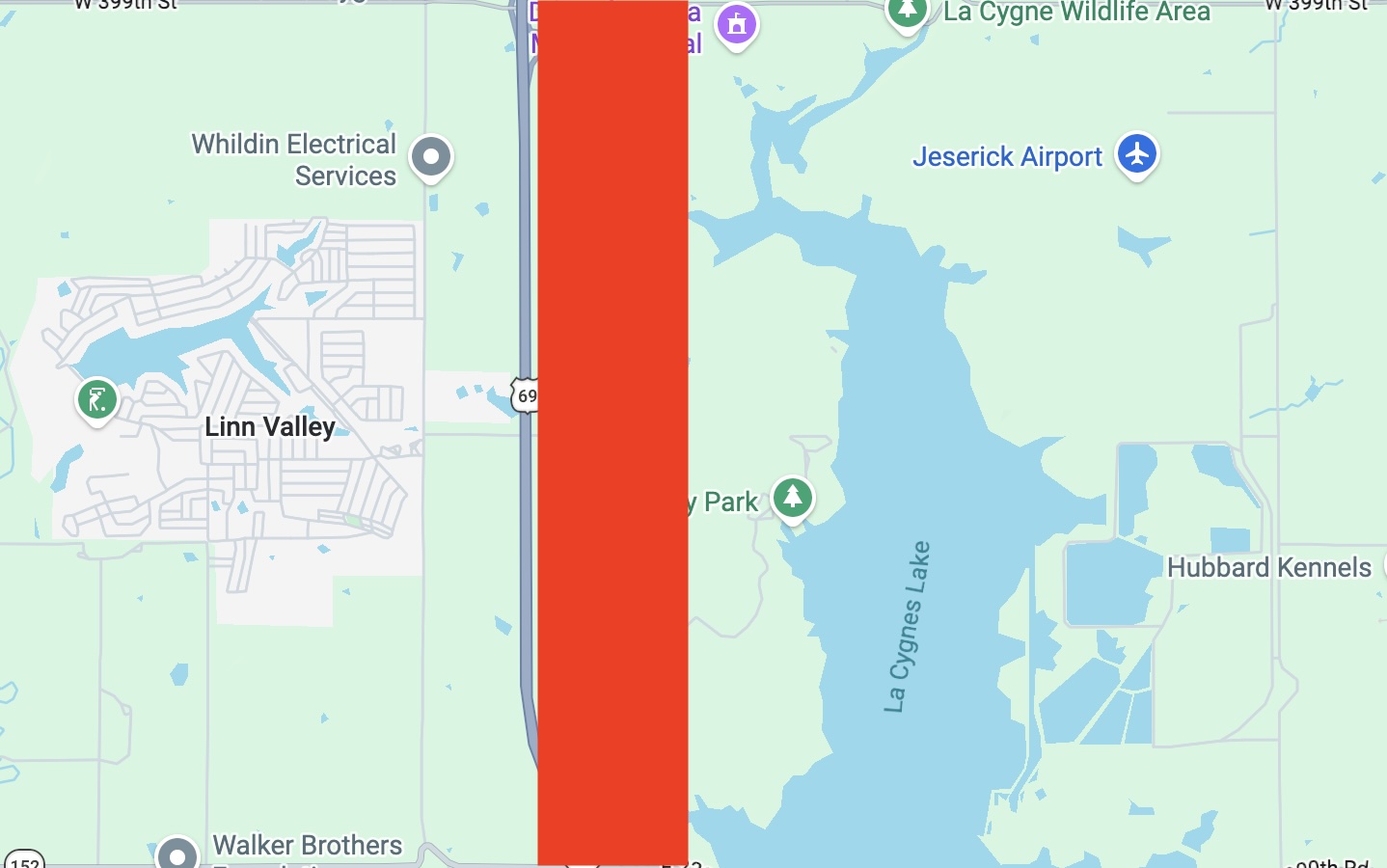
The City would not buy this land or use eminent domain to acquire it — see “Will the City buy property or use eminent domain?” below.
Could a battery storage project go outside the 'east of US-69' area?
Possibly — here’s how the City is approaching it.
The TAI district — for large uses like data centers — is focused east of US-69, away from homes and the lake.
A small battery storage facility is a different, much smaller thing. Because it supports the electrical grid, it makes the most sense next to existing utility infrastructure — such as a substation — which may sit elsewhere. The City is considering allowing small battery projects at existing utility sites, rather than forcing them into the mapped district.
The protections are the same wherever one goes: at least 500 feet from any home, full screening and landscaping, fire-safety standards (NFPA 855), and dark-sky lighting — and it would go through the public Conditional Use Permit process. No project has been approved.
Will the City buy property or use eminent domain to make this happen?
No. The City does not intend to purchase land or use eminent domain to acquire property for this.
Any sale or lease of land would be a private transaction between the current property owner and an interested party. The City is not the buyer, and it is not taking anyone’s property.
Annexation into the City is also voluntary — a property owner would choose to bring their land into Linn Valley. And because Linn County currently has a moratorium on these kinds of projects, a project like this could not move forward on land in the unincorporated county; an owner who wanted to pursue one would first need to voluntarily annex into the City, where it would then go through the City’s public review process.
What uses does the district actually allow?
The district is intended for technology and advanced-industry uses such as data centers, battery energy storage, and related advanced industry — each subject to the overlay’s standards. Uses that aren’t on the proposed list are not permitted by the overlay.
The draft ordinance’s permitted uses (each still requiring a Conditional Use Permit) are listed in Section 4: data centers; artificial-intelligence and high-performance computing; cloud infrastructure; technology campuses and research facilities; battery energy storage; electrical substations and utility support; incidental offices; and public utility infrastructure. Prohibited uses are in Section 6.
Does this allow cryptocurrency mining?
Not automatically. Cryptocurrency mining is treated as its own distinct use — it is not the same as a standard data center, even though both involve computer equipment.
Our proposed ordinance specifically calls out crypto-mining and would require additional information and a separate review before any such use could be considered. In other words, it can’t slip in under the general “data center” label.
Under Section 5 of the draft ordinance, crypto-mining is not permitted unless separately approved through enhanced findings, and it can be denied. The applicant must show significant local economic benefit, electrical-demand compatibility, noise mitigation, and compatibility with infrastructure and surrounding land uses.
Process
Will the public get to weigh in on specific projects?
Yes. Projects are reviewed in open public meetings where residents can comment. Approval typically comes with conditions the applicant must meet and the City can enforce.
Projects are reviewed by the City’s Planning and Zoning Commission and Governing Body at public meetings, and the draft ordinance also requires an applicant to hold two public information meetings before review (Section 16). Meeting dates are posted by the City.
Can I read the actual ordinance myself?
Yes — the entire draft is published on this site. We didn’t want residents to rely only on summaries.
You can read the full draft ordinance here, where every section is shown with its official text alongside a plain-language explanation of what it means. You can also download the complete draft as a PDF from that page.
Please note it is a discussion draft and may change as it moves through legal review and public input.
Is a specific project already approved or coming?
Adopting the overlay is about setting the rules and the map — it is not the same as approving a specific development. Any actual project still goes through its own review.
As of now, the TAI Overlay District ordinance is a discussion draft under review and has not been adopted, and no project has been approved by the City.
Community & Economy
What's the benefit to Linn Valley — jobs or tax revenue?
The most direct benefit of these uses is usually expanded tax base and investment rather than large numbers of jobs — data centers in particular are not big employers once operating. A broader tax base can support City services and help ease pressure on residential taxpayers.
On jobs specifically: officials in Minooka, Illinois told us a data center typically runs on about 20–25 jobs per building, averaging roughly $135,000 a year — far fewer than a warehouse’s 300–400 jobs, but at about five times the pay (their warehouse jobs averaged around $25,000), and with no truck traffic.
On infrastructure and cost: under the draft ordinance a project must fund the infrastructure its own load requires, and the City can require a professional fee agreement so the developer — not residents — pays the legal and engineering review costs. In Minooka, the developer contributed millions up front and built major road and utility improvements at its own expense — paid for by the developer, not taxpayers.
Specific projections, incentive terms, or community-benefit commitments would be shared as they are developed for any actual project. The draft ordinance also requires a Community Benefits Agreement for large projects (Section 17).
Will a data center raise my electric or water bills, or make residents subsidize it?
Short answer: not under the approach the City is taking. The central principle — for the City, and for a fast-growing number of states — is simple: a data center should pay the full cost of the power, water, and infrastructure it requires, so existing residents and businesses don’t end up subsidizing it.
Here’s how that’s protected here:
- The developer funds its own infrastructure. Under the draft ordinance, a project must pay for the utilities and upgrades its own load requires (Section 13), and large projects must enter a Community Benefits Agreement. The City can also require a professional-fee agreement so the developer — not taxpayers — pays the cost of reviewing the project (see Why We’re Considering It).
- Retail electric rates aren’t set by the City. In Kansas they’re set by the Kansas Corporation Commission (KCC), the state regulator — not by the City (more on The Power Grid).
This is now a national trend, not a fringe idea. As electricity demand from data centers has surged, more than 30 states moved in 2026 to make data centers pay their own way, and several have enacted laws doing exactly that:
- Florida — SB 484, signed May 7, 2026, bars utilities from passing data-center costs to residential and small-business customers, and preserves local governments’ power to set stricter standards or deny a project. (FL Governor’s Office, DataCenterDynamics)
- Maryland — the Utility RELIEF Act (2026) requires data centers to fund their own grid upgrades and register with the Public Service Commission. (MD Governor’s Office, Maryland Matters)
- Tennessee — HB 1847, signed May 2026, bars utilities and cities from paying for a data center’s infrastructure above a 50-MW threshold. (Good News Network)
- Alabama — SB 270 (2026) requires large data centers (150 MW and up) to cover their incremental service costs and show a benefit to other ratepayers. (MultiState)
- California, Texas (SB 6), and Oregon (the POWER Act) have enacted related measures shifting these costs onto the developers.
A few things circulating online are not yet law — and the distinction matters. The federal “GRID Act” (Senators Hawley and Blumenthal) was introduced in 2026 but has not passed (Congress.gov, NBC News), and some governors — Kentucky’s, for example — have pledged that data centers must cover their own costs even though a bill to require it has not become law.
An honest caveat: these laws are brand new, and the details of enforcement are still being worked out — Maryland, for instance, is currently contesting a large grid-upgrade bill tied to out-of-state data centers. That is exactly why the City’s plan does not rely on someone else to protect us: we write the “pay your own way” requirement directly into our own ordinance and the conditions of approval.
What does the City actually get financially — and what about the tax breaks?
A fair and important question — and an honest answer has to start with what the City does not get, because of how Kansas law works.
Two real tax breaks, named plainly:
- Kansas exempts business equipment from property tax. Since 2006, commercial and industrial machinery and equipment is exempt from property tax — and for a data center, that means the servers, by far its most valuable component (Kansas Dept. of Commerce). So a data center here would not be the property-tax windfall you read about in places like Virginia, where the giant numbers come from taxing that equipment. We won’t pretend otherwise.
- Kansas SB 98 (2025) gives large data centers (at least $250 million invested and 20+ new jobs) a 20-year exemption from sales tax on their equipment and construction (Kansas Dept. of Commerce).
So where does the real money to the City actually come from?
-
Electricity — and it is not exempt. A data center is an enormous electricity user, and a meaningful share of that comes straight to the City:
- A 5% franchise fee. Under the City’s own franchise ordinance with Evergy (Ordinance 266), the City collects 5% of the gross receipts for electricity sold to commercial and industrial customers inside the city — and a data center is exactly that.
- The City’s 1% sales tax. Kansas fully taxes commercial electricity (Kansas Dept. of Revenue), and SB 98 specifically excludes electricity from its exemption — so the City also collects its 1% local share of the sales tax on that power.
Together that’s roughly 6 cents of every dollar of the data center’s electricity bill coming to Linn Valley — on a very large bill — and none of it is exempted. Kansas law also prohibits utilities from giving data centers discounted electric rates, so they pay full price.
-
Property tax on the building and land — like a warehouse pays. The City receives its mill-levy share.
-
A Community Benefits Agreement. For a large project, the draft ordinance (Section 17) lets the City require direct contributions — road, water/sewer, and public-safety improvements, plus community investment.
-
The developer funds its own infrastructure — the power, water, and road improvements its load requires (Section 13) — so residents aren’t subsidizing it (more on Why We’re Considering It).
The honest bottom line. We can’t give a dollar figure, because no project exists and the numbers depend entirely on a project’s size and the deal the City would negotiate. What we can commit to is this: the City wouldn’t agree to anything unless the math is a real, net benefit to residents — and if a project ever came forward, we would put the actual numbers in front of you, in the open, before any decision.
And to be clear: the City is not looking to acquire land. Any land deal would be strictly between a private landowner and a buyer; the City would not purchase property or use eminent domain. Because of Linn County’s moratorium, a landowner or buyer would have to request voluntary annexation into the City — which is their choice to start, and which also means the City’s standards apply and the revenue above comes to Linn Valley rather than passing it by.